
Typing “bpd test” into Google usually comes with an unspoken follow-up question: can I actually trust the number I get back? The honest answer is mixed. This guide breaks down what a BPD test measures, why it can miss the mark in both directions and how to use your results the right way.
What a BPD Test Actually Measures
Most online BPD test are not invented from scratch. They are based on, or loosely inspired by, a real screening tool called the McLean Screening Instrument for Borderline Personality Disorder, or MSI-BPD. A team led by Dr. Mary Zanarini at McLean Hospital, which is linked to Harvard Medical School, built it back in 2003.
Invisigal a Dispatch Character Has Power to hide when she holds her breath a trending and famous character on the internet whose real name is Courtney.
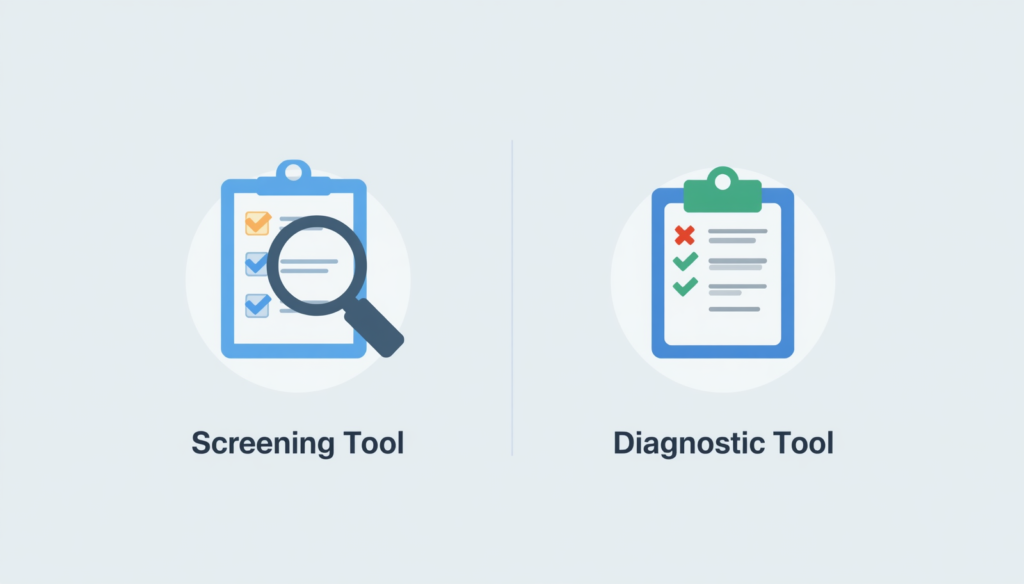
A screening tool is not the same as a diagnostic tool and that difference is the whole reason accuracy becomes a question at all. A screening tool flags people who might want a closer look. It does not confirm anything on its own, the same way a home blood pressure cuff can flag a concern but cannot prescribe medication.
The Short Answer: Are Online BPD Tests Accurate?
They are accurate at doing one narrow job and unreliable at a bigger one. As a screening tool, something like the MSI BPD test has real research behind it and does a reasonable job of flagging people who might be worth a closer clinical look. As a way to confirm or rule out BPD on your own, it is not reliable, and no test built for a website is meant to be.
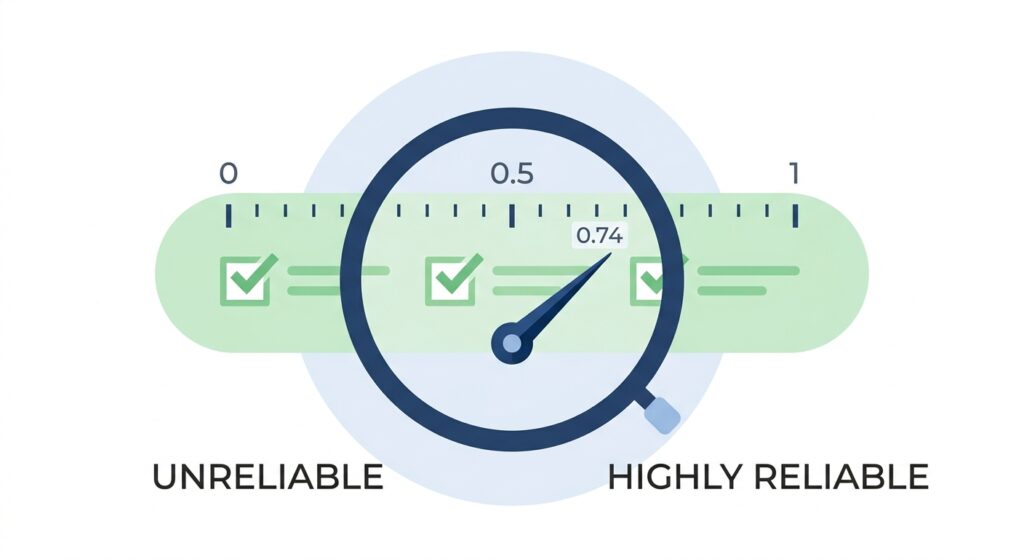
Research backs this up with real numbers, not just a general sense of “it’s probably fine.” The original 2003 study that tested this tool found a reliability score of 0.74, measured using something called Cronbach’s alpha, a common way to check how consistent a test is. That is a decent score for a short screening tool, but it is nowhere near perfect. The rest of this guide shows exactly where that gap shows up, and how it can lead to both wrong “yes” results and wrong “no” results.
The MSI-BPD: The Tool Behind Most Online Quizzes
Before judging how accurate a result is, it helps to know exactly what is being asked and how the score is built.
What the 10 Questions Cover
The MSI-BPD asks 10 yes-or-no questions. They cover things like feeling empty most of the time, anger that is hard to control, impulsive habits like overspending or substance use, relationships that swing between loving someone and suddenly resenting them, an unclear sense of who you are, and short episodes of feeling paranoid or spaced out under stress.
How Scoring Works
Each “yes” usually counts as one point, out of 10 total. In the original study, researchers used a score of 7 or higher as the point where further evaluation was worth considering. For comparison, one study of college students without a diagnosis found an average score of about 4.83. A moderate score does not automatically mean something is wrong. It means the answers are worth a professional conversation, not a self-diagnosis.
The 9 DSM-5 Signs, Explained Simply
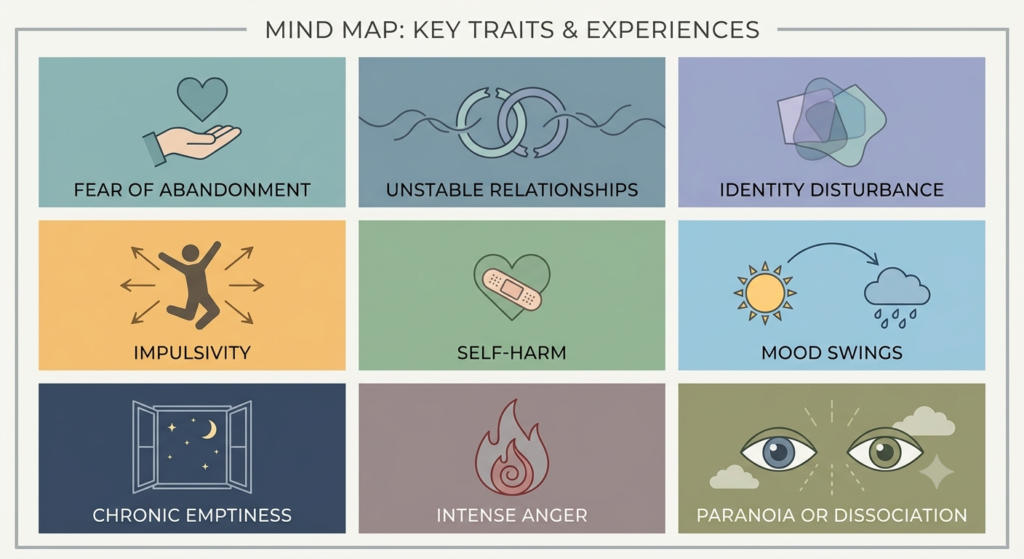
Ten quiz questions are just a shortcut version of the real list doctors use. The official manual, called the DSM-5, lists nine signs of BPD, and a person needs at least five of them to get a diagnosis. These signs also have to show up in more than one part of life, not just during one hard year or one rough relationship. Here is what each of these signs actually looks like in everyday life, not just in medical wording.
- A strong fear of being left, real or imagined, might look like panicking and begging someone to stay after they say they just need a quiet evening alone.
- Relationships often swing between “you are the best person I have ever met” and “I never want to see you again,” sometimes within the same week.
- A shaky sense of self can mean your goals, values, or even your taste in music shift depending on who you are dating.
- Impulsive habits show up as spending sprees, binge eating, or reckless driving that feel hard to stop rather than fun.
- Thoughts of suicide or self-harm are counted as their own separate sign, not lumped in with general impulsiveness.
The rest of the list includes
- mood swings that shift within hours instead of days,
- a constant sense of emptiness that does not go away even during good times,
- anger that feels too big for the moment, and
- short, stress-triggered episodes of paranoia or feeling disconnected from your own body.
Notice how much nuance lives inside just one of these nine signs. A 10-question yes/no quiz has to compress all of that into a single checkbox, which is one of the clearest reasons accuracy breaks down.
Why a High Score Doesn’t Always Mean BPD
A few other conditions share symptoms with BPD closely enough to confuse a self-test.
Complex PTSD from childhood trauma can cause very similar relationship struggles and emotional overwhelm.
Bipolar disorder also involves mood swings, though they usually last days or weeks instead of hours.
ADHD’s impulsiveness and emotional intensity can push a BPD score higher too.
This overlap is well documented, and it is a big reason full clinical interviews exist. A 10-question checklist just cannot tell these apart on its own, which means a high score is a prompt to investigate further, not a confirmed result.
Why a Low Score Doesn’t Always Rule It Out
Accuracy problems don’t only run in one direction. The MSI-BPD’s original study found it fairly reliable, but not perfect, and that 0.74 reliability score leaves real room for people to be missed. People who have built strong coping habits, or who answer cautiously because they do not see their own patterns as unusual, can end up with a lower score than their real experience would suggest. A low score is reassuring, but it is not proof of anything either.
Quiet BPD: The Blind Spot Most Tests Have
Most BPD test are built around behavior other people can see, like screaming matches, impulsive spending, or dramatic breakups. But a lot of people experience what is sometimes called “quiet” or high-functioning BPD test, where the same inner turmoil exists but points inward instead of outward. Instead of lashing out, they go quiet, pull away, or turn the fear and anger against themselves.
If you recognize the emptiness, the shaky sense of identity, and the fear of abandonment described earlier, but not the outward anger or dramatic conflict, a standard test may score you lower than what you are actually going through. This is one of the biggest and most consistent accuracy gaps in online screening, and it is worth mentioning to a professional directly if it sounds like you.
What To Do With Your Results
A number on a screen is a starting point, not an ending point, no matter which direction it points.
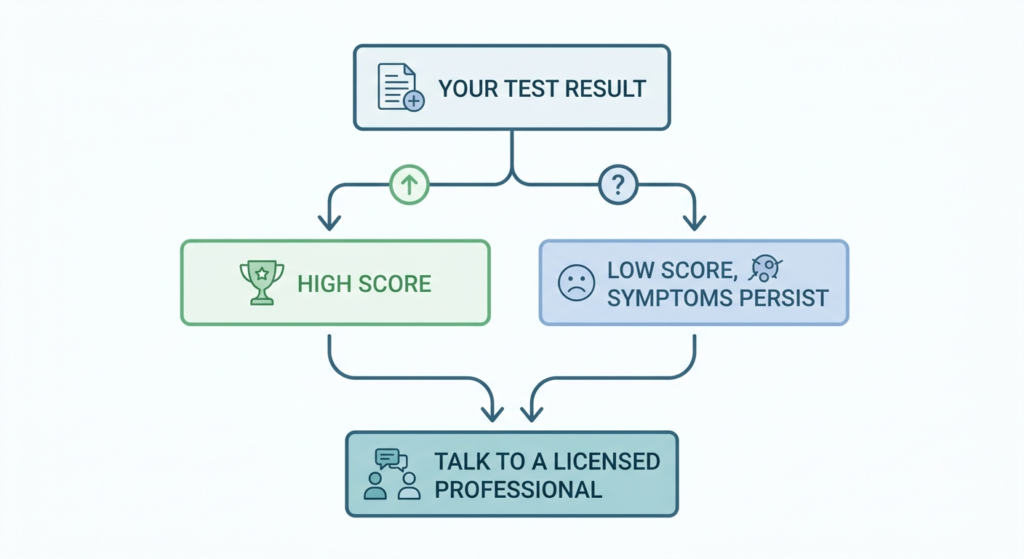
If Your Score Is High
Treat a high score as a signal to get a real evaluation, not as a diagnosis you carry around. Book time with a psychiatrist, psychologist, or licensed therapist, and bring your results as a starting point for that conversation. A proper evaluation usually involves a structured interview, and sometimes tools like the Zanarini Rating Scale, which tracks symptom severity over time.
If Your Score Is Low but Something Feels Off
Trust how you feel over the number. As covered above, self-report tools miss things, especially quiet or masked symptoms. If your relationships, sense of self, or emotions are causing real distress, that is reason enough to talk to someone, no matter what the quiz says.
How to Bring Your Results to a Doctor or Therapist
Walking into an appointment with a completed screening can make the conversation faster and more useful, as long as you present it as a starting point rather than a conclusion. Bring the specific questions you answered “yes” to, along with real examples, like a recent conflict, an impulsive moment, or a time you felt completely disconnected from yourself. Clinicians can work faster with specifics than with a general statement like “I think I might have BPD.” If you suspect a quiet or internalized pattern, say so directly, since that changes what a clinician looks for.
Conclusion
So, is a BPD test accurate? It is accurate enough to be a useful first step, and not accurate enough to be a final answer. The research behind tools like the MSI-BPD is real, but even its own numbers show meaningful room for both false alarms and missed cases, especially with quiet or internalized BPD. Use your result as a reason to have a real conversation with a licensed professional, not as a label to accept or dismiss on your own.
Frequently Asked Questions
Is a BPD test accurate?
It is moderately accurate as a screening tool but not accurate enough to diagnose anything on its own. The MSI-BPD’s original study reported a reliability score of 0.74, which is solid for a short screening tool but leaves real room for both false positives and false negatives.
Can a BPD test diagnose me?
No. Only a licensed mental health professional can diagnose BPD, through a full interview and evaluation. A test can only suggest whether further evaluation is worth it.
What is the difference between BPD and bipolar disorder?
BPD mood shifts tend to happen within hours and are tied to specific relationship moments. Bipolar mood episodes usually last days to weeks and are not as closely linked to a single trigger. The two can also occur together, so telling them apart usually needs a professional evaluation.
How many questions are on a BPD test?
Most online versions, including the widely used MSI-BPD, have 10 yes-or-no questions and take about five minutes to complete.
Can medication or mood affect my BPD test results?
This is not something the standard MSI-BPD research accounts for directly, but it is a reasonable concern. Answering during a highly stressful week, or while on medication that affects mood or impulse control, could shift how you respond to questions about anger, impulsivity, or emotional swings. If you retake the test later during a calmer period and get a different result, that is worth mentioning to a professional rather than treating either score as final.
How often should I retake a BPD test?
There is no official guideline for bpd test, since it is not meant to be tracked like a symptom diary. If you are not yet working with a professional, retaking it after a few months, especially following a major life change, can help you notice whether a pattern is consistent or tied to a specific period of stress.
Are BPD tests different for men and women?
The standard MSI-BPD does not have separate versions by gender. Research has noted that BPD test is diagnosed more often in women, but that may partly reflect diagnostic and referral patterns rather than the condition being less common in men. A professional evaluation is a better way to account for this than a fixed self-test.
Does a therapist use the same test I took online?
Sometimes, but not usually as the whole picture. A clinician might use the MSI-BPD or a similar screening tool as a starting point, but a real evaluation typically adds a structured clinical interview and often other tools, like the Zanarini Rating Scale, to look at symptom severity in more depth than a 10-question quiz can.