
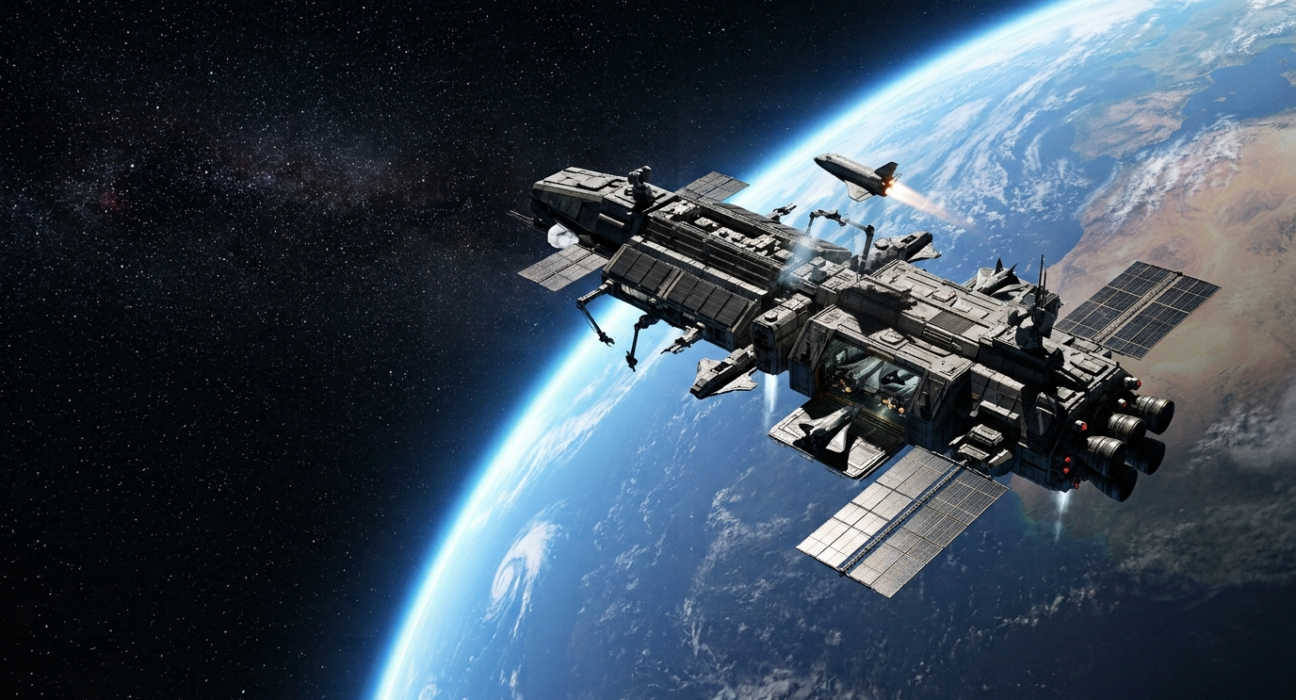
The space force orbital warship carrier sounds like a giant battleship from a science-fiction movie. The real project is more practical. The U.S. Space Force is supporting an Orbital Carrier concept from Gravitics that would keep smaller spacecraft ready in orbit for rapid deployment.
The basic idea is simple: put useful spacecraft in space before they are needed. Instead of waiting for a new spacecraft to launch from Earth after a crisis begins, operators could use a vehicle that is already in orbit. Gravitics says its Orbital Carrier is designed to support rapid response to threats, emergencies and other time sensitive missions.
That does not mean the Space Force already has an operational space battleship. The Orbital Carrier is still being developed and tested. Its real importance is the possibility of making military space operations faster and more flexible.
What Is the Space Force Orbital Carrier?
An Orbital Carrier is a spacecraft designed to pre-position other spacecraft in orbit. Those vehicles can then be deployed when a mission requires them.
The easiest comparison is an aircraft carrier. A naval carrier carries aircraft close to where they may be needed. An Orbital Carrier uses a similar idea, but its payloads are spacecraft rather than aircraft.
The comparison has limits. Aircraft can change direction relatively easily in the atmosphere. Spacecraft follow orbital paths and changing those paths takes energy and fuel. An Orbital Carrier is therefore better understood as an in-space staging platform than as a traditional warship.
Gravitics says its carrier concept would pre-position multiple spacecraft and keep them ready for rapid deployment. The goal is to reduce some of the delays that come with launching a new vehicle from Earth after a need appears.
Why Is It Called a “Space Carrier”?
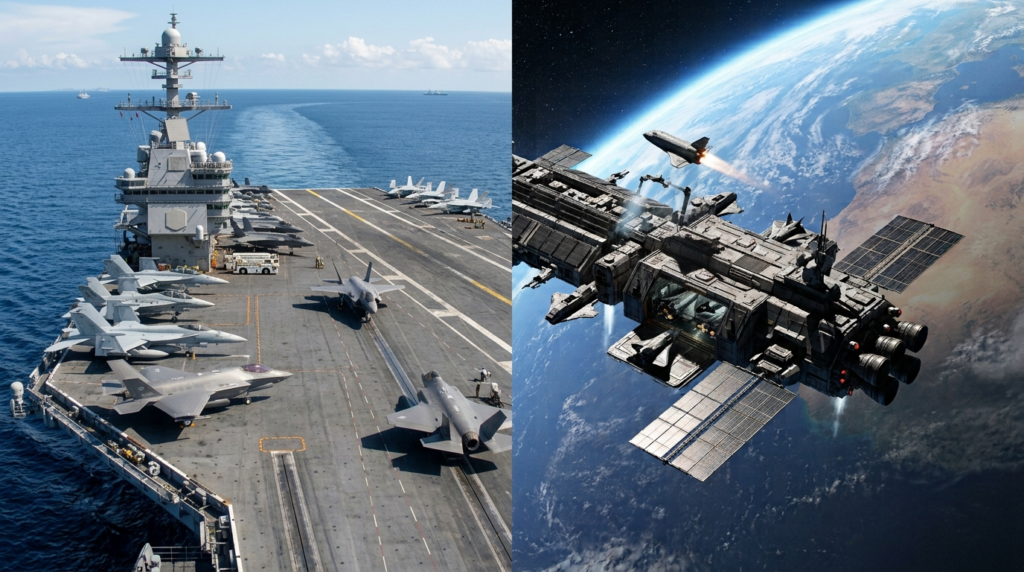
The word “carrier” describes what the spacecraft carries. A carrier could hold several vehicles or payloads and release them when operators need them. The main advantage is pre-positioning, not the size or appearance of the spacecraft.
This gives military planners another option. They could launch a vehicle from Earth, use a spacecraft already operating in orbit, or potentially deploy a vehicle from an Orbital Carrier.
The concept is therefore closer to an orbital launch platform or logistics hub than to a giant space battleship.
Is It Really a Warship?
Not in the traditional sense. There is no operational U.S. spacecraft that matches the idea of a huge armed battleship cruising around Earth. The public Orbital Carrier program focuses on keeping spacecraft ready in orbit and deploying them when needed.
However, the concept does have clear military uses. Gravitics is developing carrier designs for space mobility, emergency response and missile-defense applications. Its current public information lists Diamondback as an Orbital Carrier that can carry a Viper and payload, multiple interceptors or flexible internal volume.
So “space warship” works as a catchy description, but Orbital Carrier is the more accurate term.
Who Is Building the Space Force Orbital Warship Carrier?
Gravitics is the company publicly developing the space force orbital warship carrier architecture with support from SpaceWERX, the innovation arm of the U.S. Space Force.
In March 2025, Gravitics announced that it had been selected for a Strategic Funding Increase or STRATFI, with potential funding of up to $60 million. The funding combines government, Small Business Innovation Research, and private funds to help demonstrate and fly the Orbital Carrier.
That $60 million figure does not mean the government bought a finished fleet of space warships. It supports technology development and demonstration.
That distinction matters because the program is still moving through development and flight testing.
What Does the $60 Million STRATFI Award Mean?
The STRATFI award supports Gravitics as it moves its Orbital Carrier concept toward flight.
In April 2026, Gravitics announced a new STRATFI contract to accelerate development of the carrier architecture. The company said the work would include an Orbital Carrier pathfinder demonstration and a Viper OTX demonstration.
The pathfinder will test important parts of the system in orbit. Gravitics says the work will cover areas such as propulsion, avionics, flight software and ground systems.
That is a major difference between an artist’s concept and a working spacecraft. A vehicle can look convincing in a computer rendering and still face difficult problems once it reaches orbit.
How Does a Space Force Orbital Warship Carrier Work?
The basic idea is simple: keep spacecraft in orbit before they are needed.
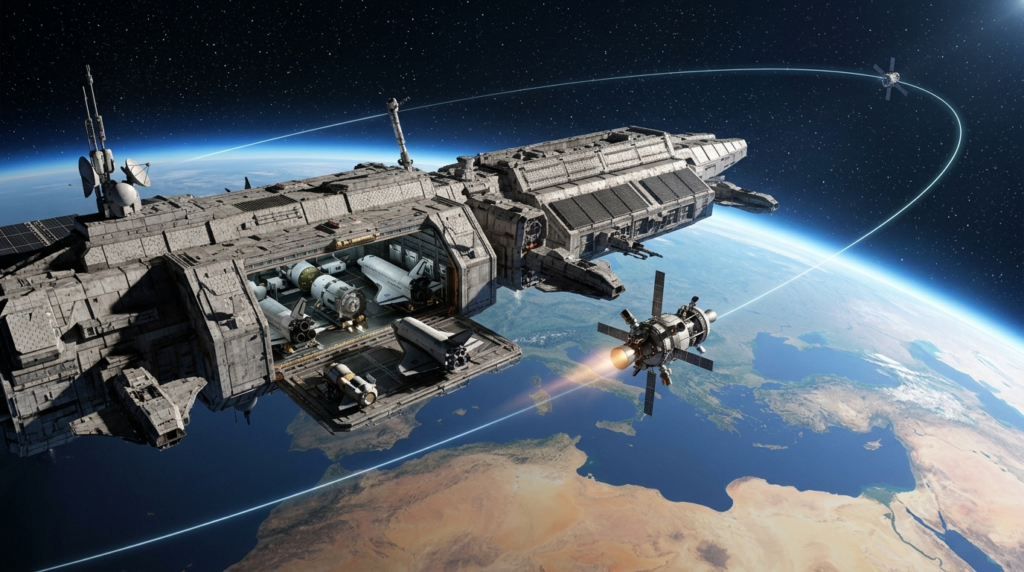
Under a traditional model, a new spacecraft may need to be prepared and launched after a mission requirement appears. The launch itself is only the beginning. The spacecraft then has to reach the right orbit and move toward its destination.
An Orbital Carrier changes the starting point. The carrier would already be in space. A smaller spacecraft would also be ready for deployment. When the mission begins, operators could release that vehicle and direct it toward its target.
That does not make the response instant. Spacecraft still follow the rules of orbital mechanics.
Pre-Positioning Spacecraft in Orbit
Pre-positioning is the heart of the Orbital Carrier idea. A spacecraft launched into orbit has a particular path around Earth. Moving to another orbit requires a change in velocity, which uses fuel. The size and direction of that change depend on where the spacecraft starts and where it needs to go.
This makes the carrier’s location important. A carrier placed in one orbit may provide a fast response to some locations but a slower response to others. The Space Force would therefore need to consider where to place carriers, how many to use and which spacecraft to carry.
The goal is not to make every point in space instantly reachable. The goal is to reduce the time between a mission decision and the deployment of a useful spacecraft.
Deploying Spacecraft When Needed
The smaller spacecraft give the carrier its flexibility. Instead of designing one large spacecraft to perform every possible mission, the carrier could hold different vehicles for different jobs. The exact payloads would depend on the final design and mission.
This modular approach could also make future upgrades easier. Operators could change the spacecraft or payload carried by the platform instead of replacing the entire carrier.
For now, the important point is that the carrier provides the infrastructure. The spacecraft it carries perform the individual missions.
What Is the Viper OTX?
The Viper OTX, or Viper Orbital Transfer Express, is another part of Gravitics’ space architecture.
Gravitics describes Viper OTX as an orbital transfer vehicle for military, civil and commercial missions. The company currently lists a payload capacity of 750 to 5,000 kilograms for missions to medium Earth orbit, geosynchronous orbit, low lunar orbit and other high-energy orbits.
Viper and the Orbital Carrier have different jobs.
The carrier is designed to keep vehicles ready in orbit. Viper is designed to move payloads between orbital destinations.
Gravitics’ 2026 plans connect the two systems. The company says it will flight demonstrate an Orbital Carrier pathfinder and Viper OTX to increase flexibility for in-space operations.
If these tests succeed, they could provide useful evidence for a broader in-space transportation system.
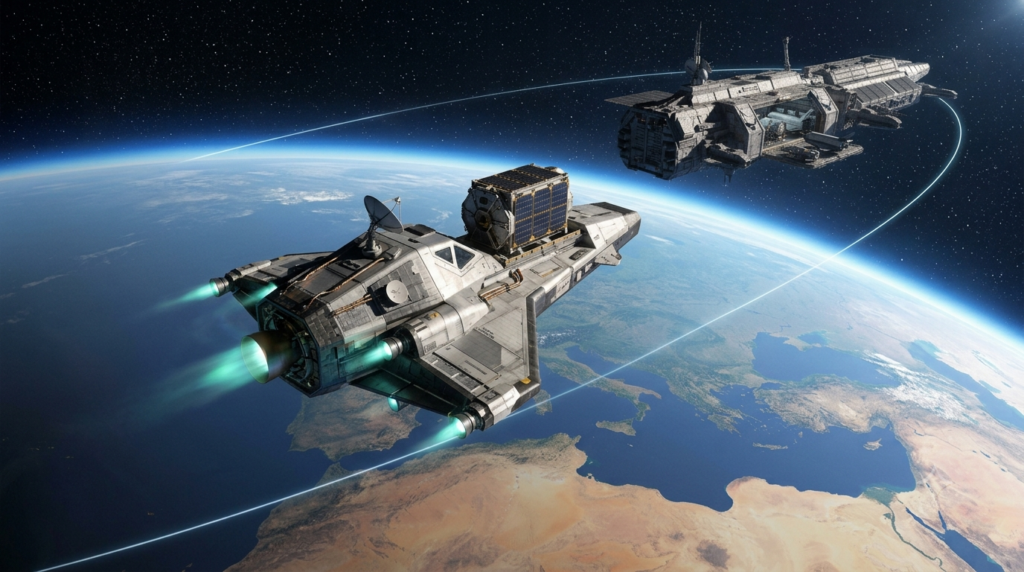
Could the Space Force Orbital Warship Carrier Carry Weapons?
Potentially, yes. But it is important to separate proposed capabilities from systems that are already operational.
In January 2026, Gravitics announced that it was one of the companies selected for the Missile Defense Agency’s SHIELD multiple-award contract. The company said the contract could create opportunities for future Orbital Carrier task orders.
Gravitics also presents Diamondback as an Orbital Carrier for space mobility, emergency response and missile defense. Its public specifications list multiple interceptors as one possible payload configuration.
That does not mean an armed Orbital Carrier is already operating in space. It means the company is developing an architecture that could support military payloads, including potential interceptor missions.
Diamondback and Space-Based Interceptors
Diamondback is one of Gravitics’ planned Orbital Carrier designs. The company currently lists a first-flight target of no earlier than 2027. It describes the vehicle as capable of carrying a Viper and payload, multiple interceptors, or 5–12 cubic meters of flexible payload volume.
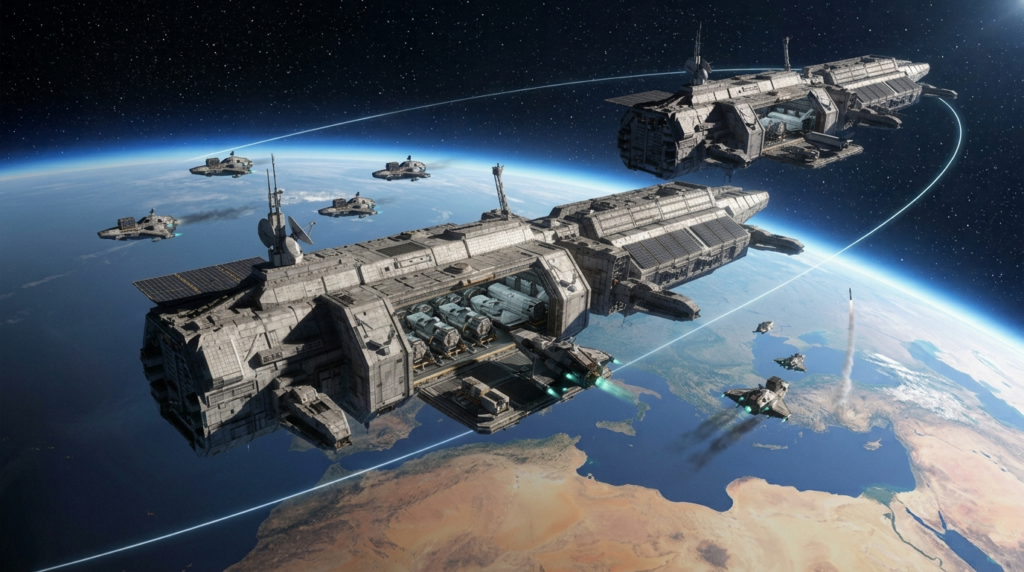
Those are company specifications and development targets, not guaranteed launch dates. The missile-defense connection is still significant. A carrier that can hold several interceptors could provide a different way to position defensive spacecraft in orbit.
But a complete space-based missile-defense system would need much more than the carrier itself. It would require sensors, tracking, communications, command systems, reliable spacecraft and an operational plan.
Orbital Carrier vs. a Science-Fiction Battleship
The difference is important. A science-fiction battleship usually combines weapons, sensors, defenses, propulsion, and smaller vehicles into one giant spacecraft. The Space Force Orbital Warship Carrier concept is more modular.
Its main job is to keep other spacecraft ready for deployment. That makes it closer to an orbital warehouse, launch platform and transportation hub than a battleship.
This distinction also explains why the carrier could have value even if it never carries weapons. Rapid deployment can matter for logistics, inspection, replacement, emergency response and other space missions.
Why Does the Space Force Want One?
The main reason is speed. Military forces depend on satellites for communications, navigation, warning, intelligence, surveillance and other missions. If an important spacecraft stops working or a new threat appears, waiting for another launch may not always be fast enough.
An Orbital Carrier offers another option: keep some spacecraft in orbit before a crisis happens.
Faster Response in Space
The Space Force has already been working on faster ways to launch and operate spacecraft.
Its Tactically Responsive Space program, or TacRS, aims to shorten the time needed to acquire, launch and operate space vehicles in response to urgent situations.
The VICTUS HAZE mission is a recent example. In June 2026, the Space Force reported that Rocket Lab received a notice requiring it to prepare for a previously unknown orbit with only 24 hours of notice. The launch then moved into on-orbit operations involving rendezvous and proximity operations.
That mission shows why rapid response matters. The Orbital Carrier takes the idea one step further. Instead of asking how quickly a spacecraft can launch from Earth, operators could use one that is already in orbit.
Tactically Responsive Space
TacRS is useful for understanding the thinking behind the Space Force Orbital Warship Carrier. A rapid launch system can reduce the time needed to get a new spacecraft into space. A pre-positioned carrier could reduce that time even further for missions that can use vehicles already in orbit.
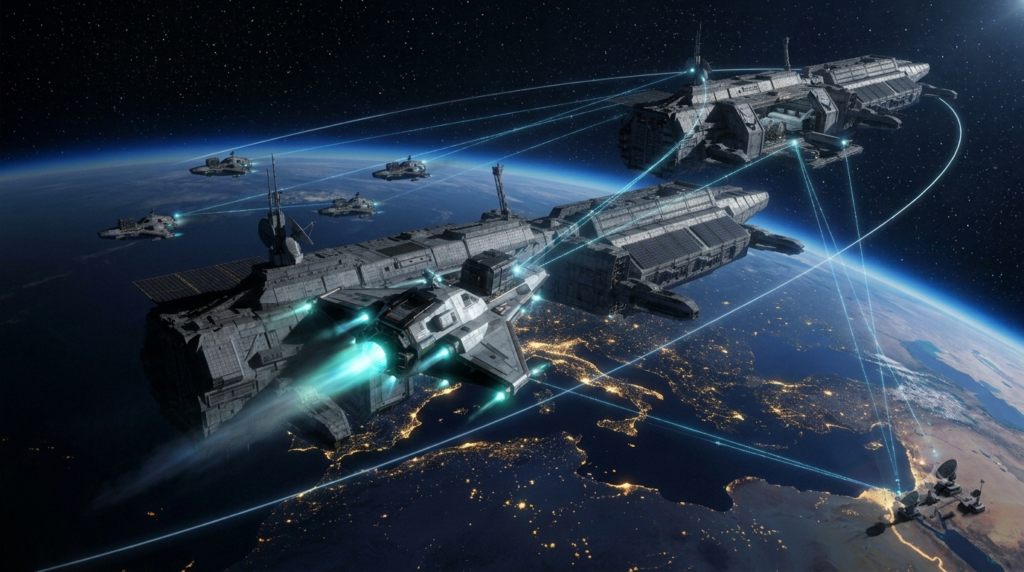
The two ideas can work together. A military space architecture does not need to choose between fast launch and pre-positioned spacecraft. It could use both, depending on the situation.
That would create more options when a satellite is damaged, a new threat appears, or operators need a spacecraft in a particular location quickly.
Orbital Warfare and Space Control
The Orbital Carrier also fits into the Space Force’s broader approach to space operations.
The 2025 Space Force Doctrine Document 1 identifies space control as one of the service’s core functions. The doctrine says space control includes offensive and defensive actions called counterspace operations. It identifies orbital warfare, electromagnetic warfare and cyberspace warfare as three mission areas within space control.
The doctrine defines orbital warfare as combat operations using fires, movement and maneuver to control the space domain.
That does not mean every Orbital Carrier mission would involve combat.
It does show why the ability to move and deploy spacecraft quickly has become an important part of military space planning.
What Could an Space Force Orbital Warship Carrier Do?
The most obvious use is rapid deployment. A carrier could keep spacecraft ready for missions such as inspection, support, replacement or defense. The exact mission would depend on the vehicle and payload selected.
Replace or Support Satellites
Consider a situation in which an important satellite becomes unavailable. A conventional response might require a replacement spacecraft to launch from Earth. Even after launch, the replacement must still reach a useful orbit.
A pre-positioned carrier could provide another option. If the right spacecraft is already in orbit, operators could deploy it and direct it toward the required location. That could reduce the response time for some missions.
It would not replace normal satellite launches. Instead, it would add another layer of resilience.
Support Missile Defense
Missile defense is one of the more ambitious potential uses. Gravitics has connected its Orbital Carrier work with the Missile Defense Agency’s SHIELD contract and presents Diamondback as a vehicle that could support interceptor payloads.
However, readers should not confuse this with an operational space-based missile-defense network.
A carrier is only one part of such a system. Sensors would have to detect and track threats, while other systems would need to provide communications, command, control and interception.
For now, the safest description is that the Orbital Carrier could support future missile-defense architectures.
Respond to Time-Critical Missions
The carrier could also support missions that are not strictly combat missions. Gravitics describes its Orbital Carrier architecture as useful for threats, emergencies and time-critical opportunities.
That broad mission set could include different types of in-space support. The basic advantage remains the same: the spacecraft starts from orbit instead of starting from a launch pad on Earth.
How to Understand the Space Force Orbital Warship Carrier
The easiest way to understand the program is to separate what has already been demonstrated from what is still being developed.
What Has Actually Been Demonstrated?
The United States has already demonstrated rapid-response space launch. VICTUS HAZE is one example.
The Space Force reported that the mission demonstrated rapid acquisition, launch and operation of space vehicles on timelines designed to respond to urgent on-orbit threats. After launch, the mission moved into realistic rendezvous and proximity-operation scenarios.
That is different from having an operational Orbital Carrier fleet. The carrier is still moving through development and testing.
What Is Still Being Developed?
In April 2026, Gravitics announced plans to flight-demonstrate a Space Force Orbital Warship Carrier pathfinder in low Earth orbit. The company says the test will help validate key systems for its wider carrier architecture.
Gravitics currently lists Diamondback’s first-flight target as no earlier than 2027. It lists Medusa’s target as no earlier than 2028. These are development targets, not guaranteed launch dates.
That distinction is important when reading headlines about a “Space Force orbital warship.” The technology is moving forward, but an operational fleet does not yet exist.
Why Orbital Mechanics Matters
In any Space Force Orbital Warship Carrier A common mistake is to imagine that an orbital carrier could simply fly anywhere in space whenever operators want.
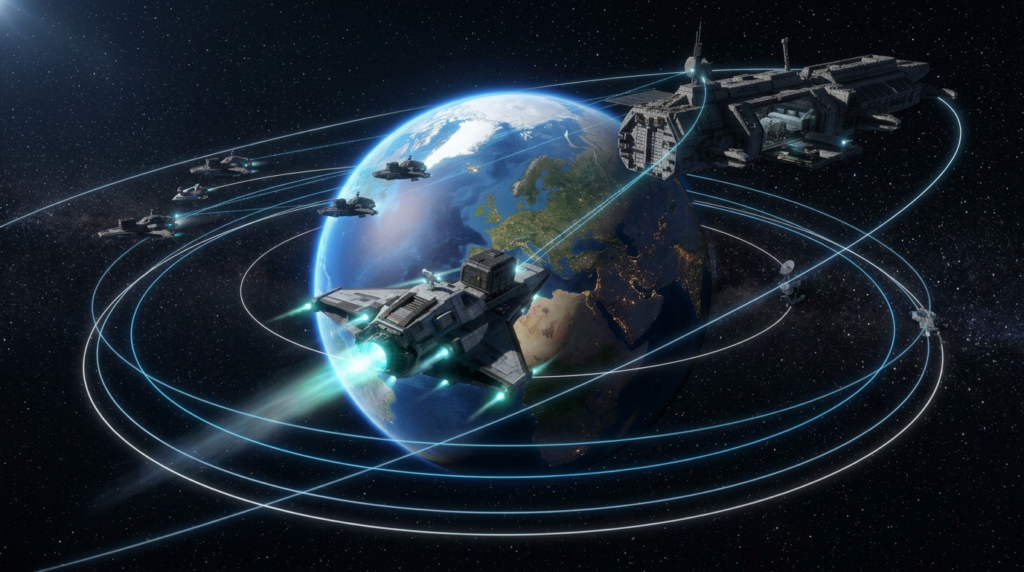
It cannot. Spacecraft follow specific orbital paths. Moving from one orbit to another takes energy and fuel. The time and fuel required depend on the starting orbit, destination, spacecraft design and planned maneuver.
That makes the carrier’s location extremely important. One carrier cannot provide the same response time everywhere around Earth. A larger fleet could improve coverage, but it would also cost more to build, launch, operate and replace.
This is one of the biggest questions for the technology: how much faster can a carrier make a mission and is that improvement worth the cost?
What Happens Next?
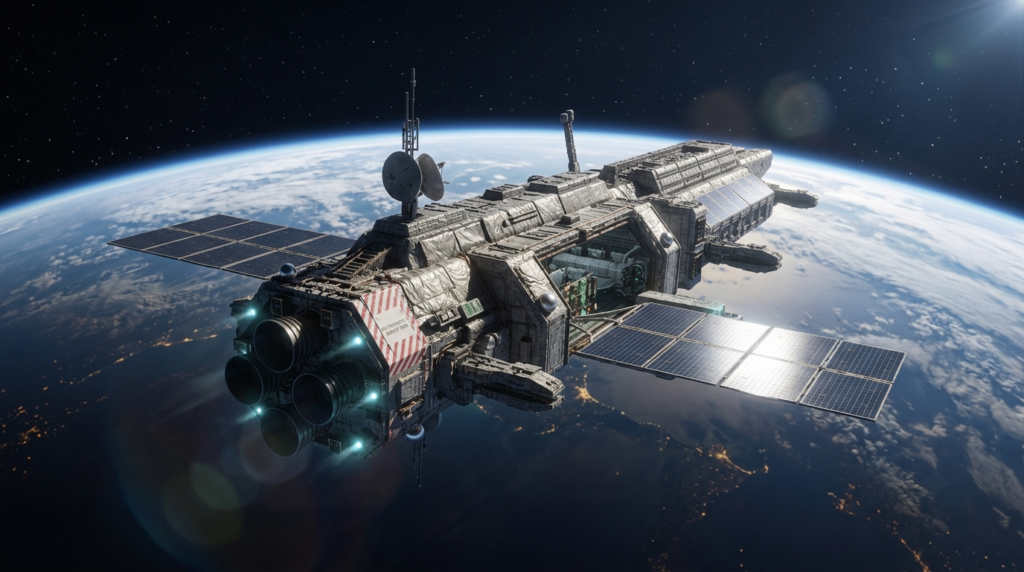
The next important stage is testing real hardware in orbit. Gravitics says its 2026 STRATFI work includes an Orbital Carrier pathfinder demonstration and a Viper OTX demonstration.
The company describes both as part of a broader effort to increase flexibility for in-space operations.
Orbital Carrier Pathfinder
The pathfinder will provide an early test of the basic technology. Gravitics says the work will validate systems such as avionics, propulsion, flight software and ground systems.
A successful test would not prove that a large military carrier fleet is ready. It would show that the basic architecture can operate in the real space environment.
That is an important step because spacecraft face conditions in orbit that are difficult to reproduce fully on Earth.
Diamondback and Medusa
Gravitics is also developing larger carrier designs.
Diamondback is intended for space mobility, emergency response, and missile defense. The company lists a first-flight target of no earlier than 2027. Medusa is a larger Orbital Carrier designed to carry up to six Viper vehicles and payloads, with a first-flight target of no earlier than 2028.
Again, these dates are targets. Spacecraft programs can change because of testing, funding, launch schedules and technical challenges.
The Main Challenge
The biggest question may not be whether engineers can build an Orbital Carrier. The harder question may be whether the carrier provides enough value to justify the cost and risk of keeping assets in orbit.
A carrier needs power, communications, propulsion, navigation, ground support and long term maintenance. It could also become a valuable target if an adversary knows where it is and what it carries. That creates a trade-off.
Pre-positioning can make a response faster, but placing several spacecraft on one platform could also concentrate valuable assets. A future system may therefore need a balance between speed, cost, flexibility and survivability.
Conclusion
The Space Force orbital warship carrier is not a giant battlecruiser waiting above Earth. The real idea is much simpler: put useful spacecraft in orbit before they are needed.
Gravitics’ Orbital Carrier is being developed as a platform that could keep spacecraft ready and deploy them when the Space Force or another customer needs them. That could make some responses faster than relying only on launches from Earth.
The concept also fits a broader change in U.S. military space planning. The Space Force now places strong emphasis on space control, orbital warfare, space access, and the ability to operate in a contested space environment.
Still, the Orbital Carrier has a lot to prove. For now, the most accurate description is an orbital carrier designed to make space operations more responsive. That may sound less exciting than a space battleship, but it is much closer to what the Space Force and Gravitics are actually developing.
FAQ’s
Is the Space Force building a space battleship?
No, not in the science-fiction sense. The Space Force is supporting development of an Orbital Carrier designed to keep spacecraft ready in orbit for rapid deployment. “Warship” is an informal description, not the official name of the program.
What is the Gravitics Orbital Carrier?
It is an orbital platform designed to pre-position spacecraft and deploy them when needed. Gravitics says the system is intended to support rapid response to threats, emergencies and time-critical missions.
Can the Orbital Carrier carry weapons?
Some planned configurations could support military payloads. Gravitics lists multiple interceptors as one possible Diamondback payload configuration. That does not mean an operational armed carrier is already deployed in space.
When will the Orbital Carrier launch?
Gravitics announced plans in 2026 to flight-demonstrate an Orbital Carrier pathfinder. The company currently lists first-flight targets of no earlier than 2027 for Diamondback and no earlier than 2028 for Medusa.
Why does the Space Force want an Orbital Carrier?
The main reason is faster response. A spacecraft that is already in orbit can potentially begin a mission sooner than one that must first launch from Earth. The idea fits the Space Force’s wider focus on Tactically Responsive Space.
Is orbital warfare already part of Space Force doctrine?
Yes. The Space Force’s 2025 doctrine identifies orbital warfare as a mission area within space control and defines it as combat operations involving fires, movement, and maneuver to control the space domain.
Conclusion
The Space Force orbital warship carrier is not a giant battlecruiser waiting above Earth. The real idea is much simpler: put useful spacecraft in orbit before they are needed.
Gravitics’ Orbital Carrier is being developed as a platform that could keep spacecraft ready and deploy them when the Space Force or another customer needs them. That could make some responses faster than relying only on launches from Earth.
The concept also fits a broader change in U.S. military space planning. The Space Force now places strong emphasis on space control, orbital warfare, space access, and the ability to operate in a contested space environment.
Still, the Orbital Carrier has a lot to prove.
The upcoming pathfinder test matters more than the dramatic “space warship” label. If the technology works well in orbit, it could become part of a larger rapid-response space system. But high costs, orbital limits, and security risks could keep the system from becoming widely used.
For now, the most accurate description is an orbital carrier designed to make space operations more responsive. That may sound less exciting than a space battleship, but it is much closer to what the Space Force and Gravitics are actually developing.





What Is a Riser Desk? 7 Things to Know Before You Buy
August 6, 2026[…] riser desks are lightweight enough to move between rooms or even carry to a coworking space. When folded, they occupy minimal storage space which is a major advantage over bulky, fixed […]